
Commitment Over Compliance
Commitment can be easy to spot if we know where to look. Lionel Messi, competing at the highest level well into his late thirties, has spoken about the importance of team success, personal character, and the people who helped him throughout his career. That kind of clarity reflects something rules and requirements cannot produce: a deeper reason to keep showing up with discipline, effort, and care. The same quality shows up in every profession, and leaders who build it in the people around them accomplish something compliance alone could never achieve.
Committed people are easy to recognize. Their actions and words set them apart, and they often bring a sense of purpose and positivity to their roles. Compliant people are easy to identify as well: they do what they are supposed to do, but not much else. Often, the goal becomes getting through the day and doing what needs to be done to keep the work moving. Most leaders would say they want committed teams, and most would also admit that they more often get compliance.
External expectations can carry us for a while. Someone might meet the standard because direction was given or because a consequence might follow. That kind of motivation has a ceiling, and when people do not understand the “why” behind what they are doing, compliance can only take us so far.
“My motivation comes from playing the game I love.”

Self-Assessment: Commitment Over Compliance
Please take a few moments to reflect on the following questions. Where can you identify opportunities for growth in your leadership?
Can I explain the purpose behind the responsibilities I’m asking others to complete?
Am I helping people understand why required work deserves attention and care?
Do I recognize when someone is meeting the standard without feeling connected to the work?
Have I considered whether people are acting from commitment or only responding to pressure?
Can I identify where clear standards help people commit more fully to the outcome?
Am I removing barriers that may make committed effort harder to sustain?
Do I reinforce the value of the work when people complete required responsibilities well?
Does my own approach to required work reflect the commitment I want to encourage in others?
This self-assessment is a starting point for understanding Commitment Over Compliance as a leader. Reflect on your responses, identify areas for growth, and use feedback from others and your ECFL Leadership Coach to guide your development.


Creating a culture of commitment starts with the way leaders frame responsibilities. People are more likely to commit when they understand what is expected and why their role matters. Clear direction helps people know what needs to be done, while purpose helps them understand why the work deserves their attention.
The Hierarchy of Commitment shows the full range of ways we may respond to a responsibility, from active resistance to genuine commitment. At the lowest level, people may resist the responsibility or influence others away from it. At the next level, they may question its value and participate only when required or pressured.
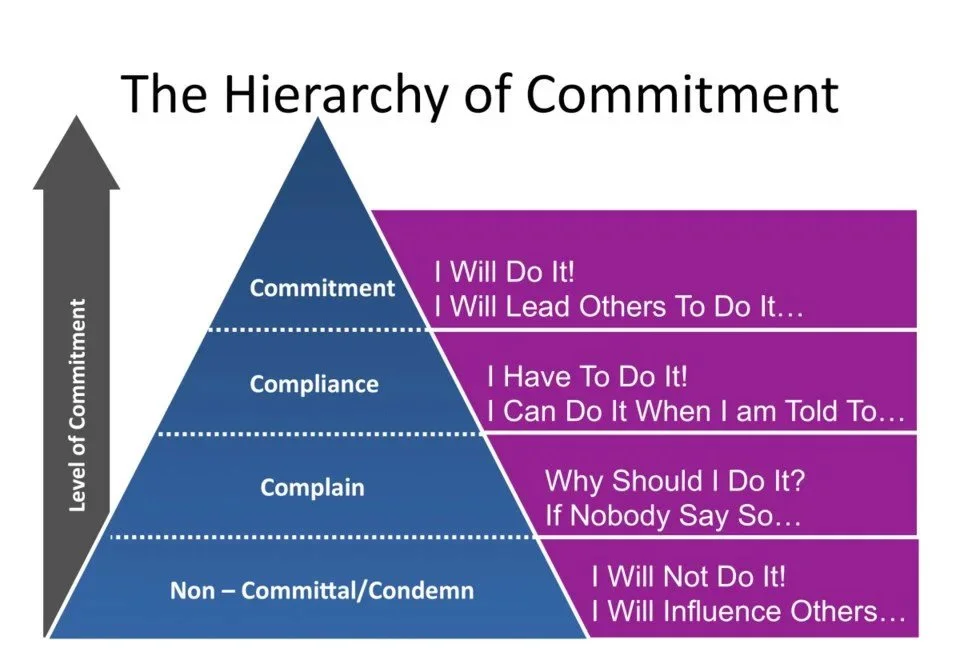
Compliance comes next, as people meet the requirement because direction has been given. Commitment is the strongest level because people choose to act and understand what the work supports.
Compliance gives the team a necessary baseline. Reliable work depends on people following standards and meeting expectations. Leaders who model commitment while upholding compliance make it easier for the people they lead to connect their efforts to a larger purpose. Commitment develops when people doing the work understand how their role affects the bigger picture.
When priorities are unclear, decisions are delayed, or information is missing, people may appear uncommitted even when the system around the work is the source of the problem. Before making that assumption, we need to look at the environment we’re shaping and ask whether people have the clarity, context, and support they need to give the work their focused effort.
Leaders who shape the environment make it easier for people to move from compliance toward commitment. This can include:
Communicating priorities clearly and revisiting them when things change.
Making decisions in a reasonable time frame so people aren’t left waiting to move forward.
Sharing the context people need to understand how their work connects to the larger outcome.
Stepping in when workload, resources, or competing demands are getting in the way.
Asking questions before drawing conclusions about someone’s level of effort.

Engagement and commitment require us to care about something beyond the immediate requirement. External motivation can move us to act, but the effort tends to stop once the requirement has been met. When direction and consequences are the primary drivers, meeting the expectation feels like enough because the goal was never the outcome itself.
Psychologist Frederick Herzberg's research on workplace motivation offers a useful frame here. Herzberg found that job satisfaction and dissatisfaction aren't opposite ends of the same scale; instead, they operate on two separate "dimensions." Satisfaction comes from intrinsic sources: a sense of achievement, recognition, responsibility, and opportunities for growth. Dissatisfaction develops when extrinsic factors like working conditions, compensation, or security feel inadequate. A person may stay compliant as long as those extrinsic factors are acceptable, but removing dissatisfaction doesn't generate commitment. Committed people are motivated by what they find meaningful in the work itself, and that fulfillment makes them more likely to persist when things get difficult.
Internal motivation asks something different of us. Caring about what our efforts produce, rather than simply completing what's required, takes a degree of courage: the willingness to invest in an outcome we don't fully control. That investment is what separates people who meet the standard from people who protect it. Engagement grows when we bring that kind of attention to our responsibilities because we understand what they support, not because we've been told to.
“Understanding gets compliance. Only belief gets commitment.”
Being committed also changes the things we pay attention to. When we only see a task as an item to cross off a list, we may only focus on our portion of the job. When we understand what our role affects, we're more likely to notice when something could weaken the outcome or create avoidable rework. That added attention is what commitment looks like in practice, because we're thinking beyond completion and considering what our efforts are meant to produce.
The difference can be seen in how we approach the same responsibility:
Compliance sounds like: "I did what was required."
Commitment sounds like: "I understand what this affects, so I'm going to do it carefully and follow up on the result."Compliance focuses on completing the task.
Commitment focuses on protecting what the task is supposed to support.Compliance waits for direction when something changes.
Commitment asks what needs attention so the work can continue responsibly.Compliance meets the standard because expectations are clear.
Commitment meets the standard because we understand the reason behind it.
Motivation is where engagement and courage intersect. When we understand how our work affects others, commitment takes courage because we're choosing to invest in an outcome we can influence but can't fully control. We build engagement when we help those we lead see how their efforts contribute to operational discipline and success at 3M.


As leaders, we need to encourage engagement because committed employees help the organization perform better. When people are engaged enough to go above and beyond, they bring stronger effort and take more initiative. Here are some best practices for curating this kind of commitment:
Connect Work to Greater Purpose: Before asking for action, give enough context for people to understand why the responsibility is important. People are more likely to commit when they understand how their work supports safety, quality, customer outcomes, efficiency, reliability, or business performance. Clear instructions tell people what to do, but a clear purpose helps people understand why their effort deserves attention. A task may still get completed without context, but context sets us up to do our best.
Clarify What Excellence Looks Like: After people understand why the responsibility is important, they also need to know what has to be done. Some responsibilities have standards that need to be followed every time. When the minimum is clear, people understand what compliance looks like before they consider how to go above and beyond. Leaders need to define what strong performance looks like, how success will be measured, and what separates basic completion from excellent execution.
Create Room for Initiative: People need meaningful opportunities to use their engagement, not just encouragement to show it. When someone has demonstrated strong follow-through, part of our role as leaders is to give them appropriate room to contribute more fully. That might mean inviting them into a problem, asking for their perspective, or giving them more responsibility because they’ve shown they’re ready for it.
Recognize Contributions Personally: Recognition should identify the specific behavior that supported the outcome. Calling out the preparation, follow-through, problem-solving, disciplined execution, or support for others that a team member has committed to helps teams understand which contributions strengthen performance. Recognition is one of the most effective tools for reinforcing the right behaviors.
Remove Barriers: People may appear uncommitted when the work is slowed by unclear priorities, delayed decisions, missing information, workload pressure, or poor handoffs. Leaders need to examine friction in the system before judging individual effort.

Compliance gives us a necessary baseline, and commitment takes us further. When we understand the purpose behind our responsibilities and have the courage to invest in outcomes we can influence but can’t fully control, engagement stops being an expectation and starts becoming a choice.
Operational discipline depends on people who understand what their efforts are meant to protect, not only what they are expected to complete. As a leader, examine where the people you lead are crossing tasks off a list and ask what they need to move from meeting the standard to committing to the purpose behind it. What about yourself?

Strengthen your understanding of Commitment Over Compliance by sticking with the following resources. Use this opportunity to note new insights and adhere to practices that will enhance your leadership journey.